

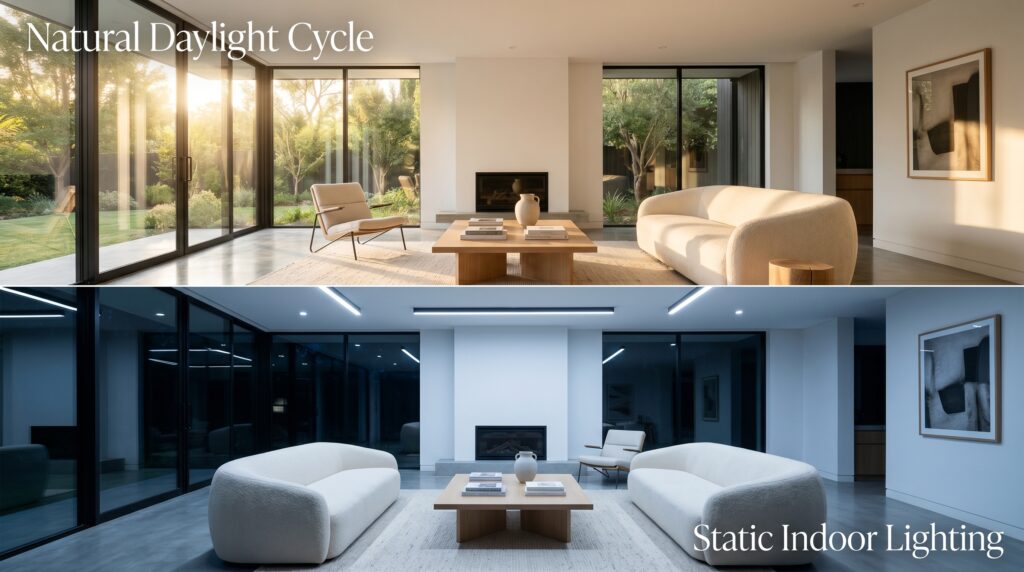
Human biology did not evolve to exist under the static, unyielding glare of industrial fluorescence, nor did it evolve to stare into blue-shifted, high-luminance pixel matrices long after sunset. For hundreds of thousands of years, our endocrine systems and neurological pathways were governed by a singular, flawless celestial clock: the dynamic shift of natural sunlight from the crisp, blue-toned clarity of dawn to the warm, low-intensity amber glow of dusk.
Today, the average modern individual spends over 90% of their life indoors, sealed inside architectural envelopes that isolate them from these crucial environmental cues. By living and working under static artificial lighting, we subject our bodies to a state of perpetual “indoor twilight” or accidental nighttime activation. This profound disconnect disrupts our circadian rhythms—the internal 24-hour biological clocks that govern everything from cellular repair and cortisol production to deep delta-wave sleep transition.
To reclaim your sleep quality, morning alertness, and baseline cognitive energy, you must look beyond decorative light fixtures and embrace the principles of biodynamic design. By intentionally implementing circadian lighting design at home, you treat your spatial illumination not merely as a visual utility, but as a powerful, non-pharmacological tool for biological optimization.
1. The Science of Light Perception: How Space Signals the Brain
To understand how lighting alters your state of mind, you must look at the specialized anatomy of the human eye. Beyond the rods and cones that allow us to see shapes and colors, our retinas contain a third class of cells: intrinsically photosensitive retinal ganglion cells (ipRGCs). These cells do not contribute to conscious sight; instead, their sole purpose is to measure ambient environmental light and report those metrics directly to the suprachiasmatic nucleus (SCN)—the master biological clock situated within the hypothalamus.
The ipRGCs are uniquely sensitive to a very narrow band of light wavelengths: the blue spectrum, peaking between 460 and 490 nanometers. When short-wavelength blue light hits these cells, they send an immediate electrical signal to the SCN, suppressing the production of melatonin (the hormone responsible for sleep and cellular recovery) while simultaneously triggering the release of cortisol, elevating your heart rate, and boosting morning alertness.
When your home layout exposes you to blue-rich light at the wrong biological time—such as turning on bright overhead bathroom LEDs at 10:00 PM—the ipRGCs trick the SCN into believing it is high noon. Melatonin production is instantly halted, pushing back your natural sleep window, fragmenting your REM cycles, and leaving you feeling chronically exhausted the following morning. Circadian lighting design corrects this by aligning your indoor landscape with your body’s predictable biochemical needs.
2. Setting the Morning Baseline: Sky-Blue Lux and Cortisol Activation
The foundation of a healthy circadian cycle begins the exact moment you wake up. To properly anchor your internal clock, your suprachiasmatic nucleus requires an immediate, high-intensity environmental cue to signal that the daytime phase has officially commenced. This morning anchor suppresses lingering nighttime melatonin and kickstarts your natural cortisol awakening response, which dictates your energy levels for the entire day.
Maximize Early Solar Exposure
Architecturally, the most effective morning light source is direct, unmitigated solar radiation. Within the first 30 minutes of waking, open all window treatments fully. Position your morning routine—whether it is drinking your coffee, journaling, or stretching—directly adjacent to your largest east-facing windows.
Natural morning daylight delivers a massive dose of blue-spectrum light and registers at an intensity ranging from 10,000 lux to over 25,000 lux (even on an overcast day), a threshold that standard indoor lighting simply cannot replicate.
Supplementing with Biodynamic Blue-Rich Lighting
If your architectural layout lacks sufficient eastern exposure, or if you must wake up before dawn, you must simulate this morning activation artificially. Replace standard warm bulbs in your primary morning zones—such as the kitchen or home office—with high-output, full-spectrum LED fixtures calibrated to a crisp 5000K to 6500K color temperature.
Ensure these morning fixtures provide a high lux delivery at eye level. By flooding your immediate visual field with cool, high-intensity light for the first two hours of the day, you cleanly reset your biological clock, laying the necessary groundwork for a deep, natural crash into sleep exactly 16 hours later.
3. The Midday Transition: High-Luminance Analytical Spaces
As the morning transitions into midday, your lighting architecture should evolve to support sustained intellectual output, focus, and visual acuity. During this phase, your biological goal is to maintain a stable, high-energy baseline without over-stimulating the nervous system or inducing eye strain.
The classic design error during the afternoon is relying entirely on unbalanced light pockets—such as a single bright desk lamp illuminating a laptop while the rest of the room sits in deep shadow. This creates intense visual contrast, forcing your pupils to constantly dilate and contract as your eyes shift focus, culminating in physical headaches and rapid cognitive fatigue.
Instead, create a balanced, high-luminance environment using a combination of direct and indirect light paths:
| Daytime Zone | Primary Light Source | Color Temperature | Design Intention |
| Workspace Niche | Bounced Wall Wash + Task | 4000K (Neutral White) | Provides crisp text clarity, reduces contrast glare, and sharpens visual focus. |
| Kitchen / Dining | Diffused Downlighting | 3500K – 4000K | Creates an open, bright space that mimics peak midday solar distribution. |
| Transition Corridors | Ambient Linear Profiles | 3500K | Eliminates dark shadow pockets between rooms to maintain smooth visual transition. |
To execute this beautifully, utilize adjustable architectural track lighting or directional spotlights directed toward your walls rather than the floor. Bouncing neutral white light (3500K – 4000K) off soft, matte plaster surfaces creates a highly diffused, shadowless environment that floods the room evenly, providing the necessary ambient lux to keep your mind alert and your eyes fully at ease during long working blocks.
4. The Evening Sanctuary: Transitioning to Visual Silence
If the morning is about activation, the evening is strictly about environmental protection. As sunset approaches, your spatial lighting architecture must undergo a radical shift. To allow your nervous system to wind down and shield your ipRGCs from disruptive inputs, you must systematically eliminate all blue-spectrum light from your visual field.
Shift the Altitude of Light
In nature, as the sun sets, light moves from high overhead to low on the horizon. Mimic this architectural shift by completely turning off all recessed ceiling downlights past 7:00 PM. High-altitude overhead lighting inherently signals daylight to the brain.
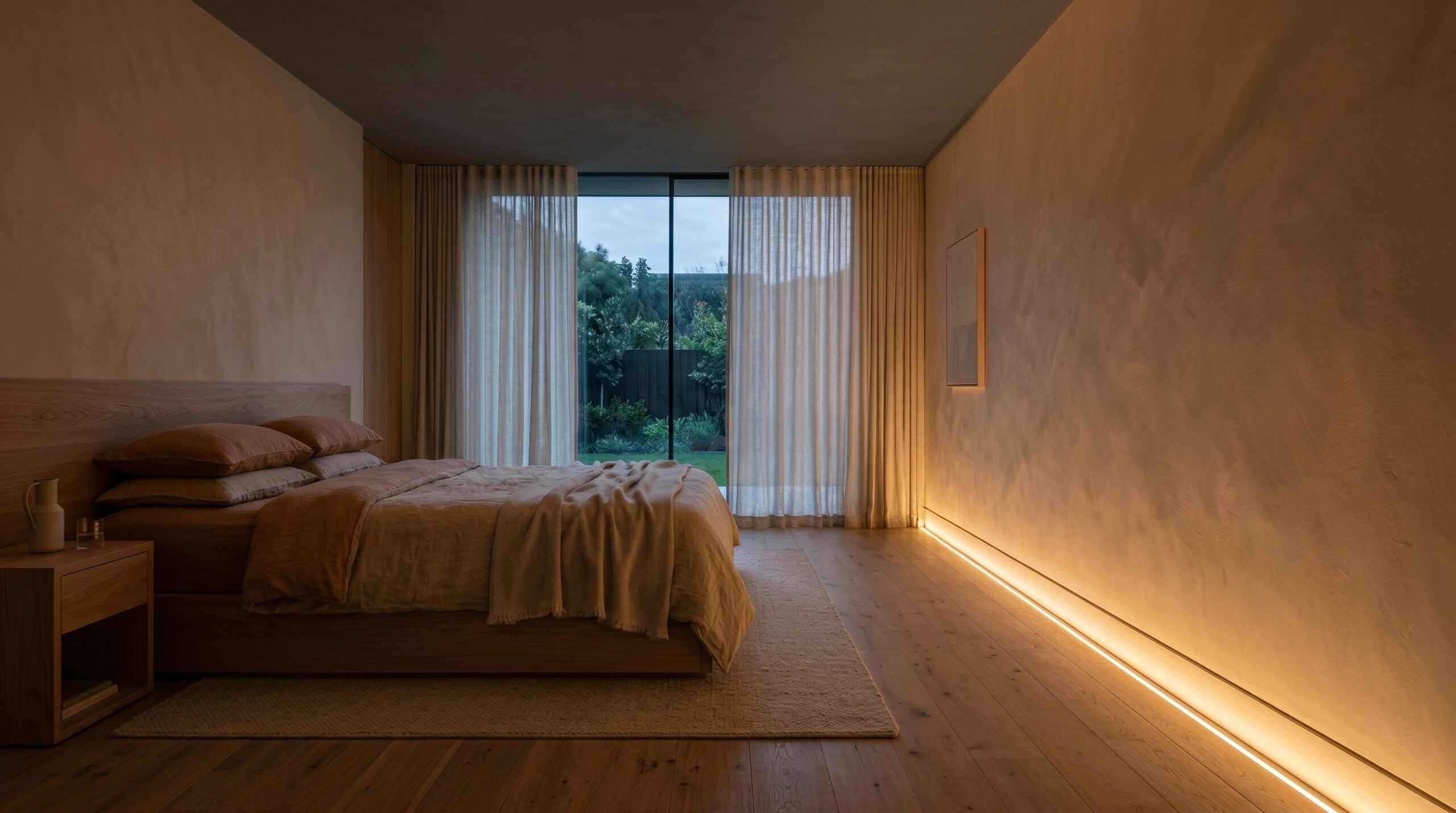
Instead, rely exclusively on low-altitude lighting placement: baseboard accent strips, low-profile table lamps hidden behind furniture, or low-sitting floor lamps. Keeping light sources below eye level drastically reduces the amount of light that hits the highly sensitive lower half of your retina, protecting your evening wind-down phase.
Drop the Kelvin to Warm Amber
Every evening bulb in your home sanctuary—especially in the bedroom and living lounge—should be strictly limited to a ultra-warm, low-intensity range between 2200K and 2700K. Better yet, introduce true amber LED bulbs or dimmable incandescent fixtures that emit a rich, campfire-like orange glow.
This specific spectrum completely bypasses the blue-sensitive ipRGC receptors, allowing your brain to secrete melatonin naturally and unhindered. Pair these warm light sources with highly opaque linen or heavy pleated fabric lampshades. These materials diffuse the output into a soft, velvety wash of light, creating an editorial, high-end look that transforms your evening space into a low-stimulus, deeply therapeutic sanctuary for mental recovery.

[…] your natural metabolic flow. For instance, engineer a gradual 2-to-3-degree temperature drop exactly 60 minutes before your scheduled bedtime block. Cooler ambient air signals the human nervous system to initiate its natural nocturnal […]
[…] If a lighting gift is part of the plan, warmer, lower color-temperature light in the evening genuinely supports winding down better than harsh cool-white overhead light — we cover the real research behind this (and what color temperatures to actually look for) in our full guide to circadian lighting at home. […]
[…] light signals alertness while warm light signals a slower pace, covered in more detail in our circadian lighting guide. A small under-cabinet strip or a single dedicated fixture over just this zone does real work […]
[…] circadian wake-up signal than an overhead bulb — the same mechanism covered in more depth in our circadian lighting guide. If getting outside isn’t practical, a bright, cool-toned lamp is a reasonable […]