
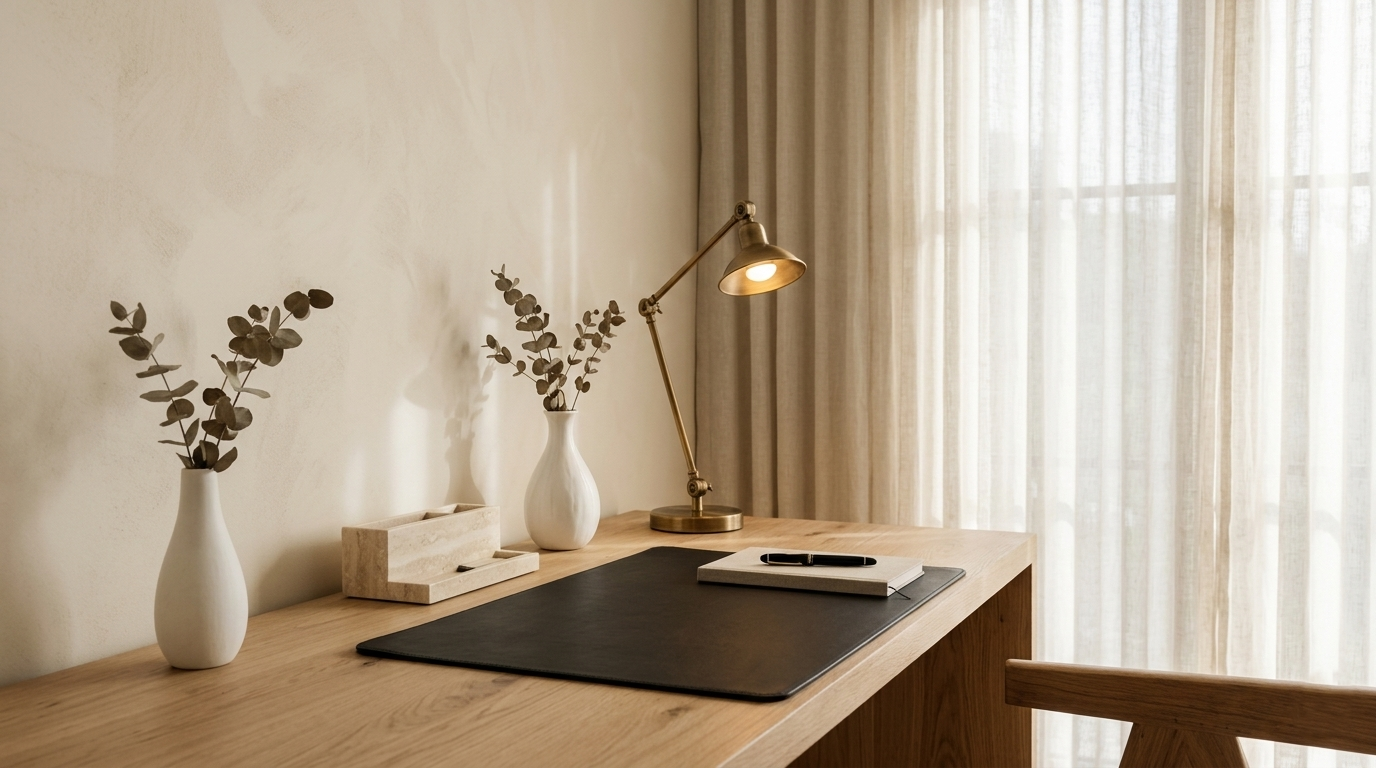

A workspace that helps you focus isn’t just about removing distractions — the materials, sounds, and even scents around you measurably affect how well your brain sustains attention. Here’s what’s actually backed by research, and how to apply it without a full renovation.
Why Switching Tasks Costs You More Than It Feels Like
Every time you glance at a notification and back, you’re not just losing the seconds it takes to look — you’re paying what researchers call a “switch cost.” Studies on task-switching, including foundational work reviewed by the American Psychological Association, show that shifting attention between tasks engages the brain’s frontal and parietal regions and measurably slows performance compared to staying on one task. Some research estimates switching can cost as much as a significant chunk of otherwise-productive time across a workday, though exact figures vary by study and task type.
Practical takeaway: a workspace that reduces the temptation to switch — phone out of sight, one browser tab, notifications off — isn’t just tidiness. It’s directly reducing a real cognitive tax.
Wood Isn’t Just an Aesthetic Choice
This one has genuinely solid, peer-reviewed backing. Multiple studies — including Japanese research measuring physiological responses to touching different materials, and a 2024 study published in a peer-reviewed design journal — found that contact with uncoated wood surfaces increased heart rate variability (a marker of the parasympathetic “rest and recover” nervous system response) and calmed prefrontal cortex activity, compared to materials like marble, tile, or stainless steel. Participants in wooden rooms also breathed more slowly and reported more positive mood.
Practical takeaway: a real wood desk surface, a wooden chair arm you actually rest your hand on, or even a small wooden object within reach isn’t just a design choice — there’s a measurable physiological calming effect tied to it.
What the Research Actually Says About Scent and Focus
This is where it’s worth being honest about mixed evidence rather than stating it as settled fact. Some studies — including EEG research on lavender inhalation — found improvements in attention and cognitive flexibility during task-switching tests. Other reviews describe the overall aromatherapy research base as inconsistent, with real questions about study quality and placebo effects. A few specific findings worth noting: lavender has shown effects on sustained attention in multiple studies, and one 2020 study found a peppermint-rosemary blend improved reaction time and accuracy on attention tasks compared to a control group.
Practical takeaway: scent is a “might help, low-risk to try” category, not a guaranteed fix. If you want to experiment, a small amount of a single, real essential oil (not a synthetic fragrance) during focused work is a reasonable low-cost test — just don’t expect it to substitute for actually removing distractions.
A Practical Setup, Not a Renovation
- Reduce switching temptation first — this has the strongest evidence behind it. Phone in another room, single task or tab visible.
- Add one real wood surface or object within arm’s reach — a desk, a chair detail, even a small tray.
- Optional: test scent for yourself. Evidence is real but mixed, so treat it as a personal experiment, not a guaranteed intervention.
- Keep visual clutter low — a cleared desk reduces the number of things competing for attention before you’ve even opened a task.
Bottom Line
Some of what gets called “focus design” is genuinely backed by measurable physiological research — task-switching costs and wood’s calming effect on the nervous system are both well-documented. Scent is more promising than dismissible, but the evidence is still developing, and it’s worth treating it that way rather than presenting it as a guaranteed fix.
Sources: American Psychological Association research summary on multitasking and task-switching; peer-reviewed studies on physiological effects of touching wood (heart rate variability and prefrontal cortex activity); published research on lavender and blended essential oils’ effects on attention and cognitive flexibility.

[…] As the morning transitions into midday, your lighting architecture should evolve to support sustained intellectual output, focus, and visual acuity. During this phase, your biological goal is to maintain a stable, high-energy baseline without over-stimulating the nerv…. […]