
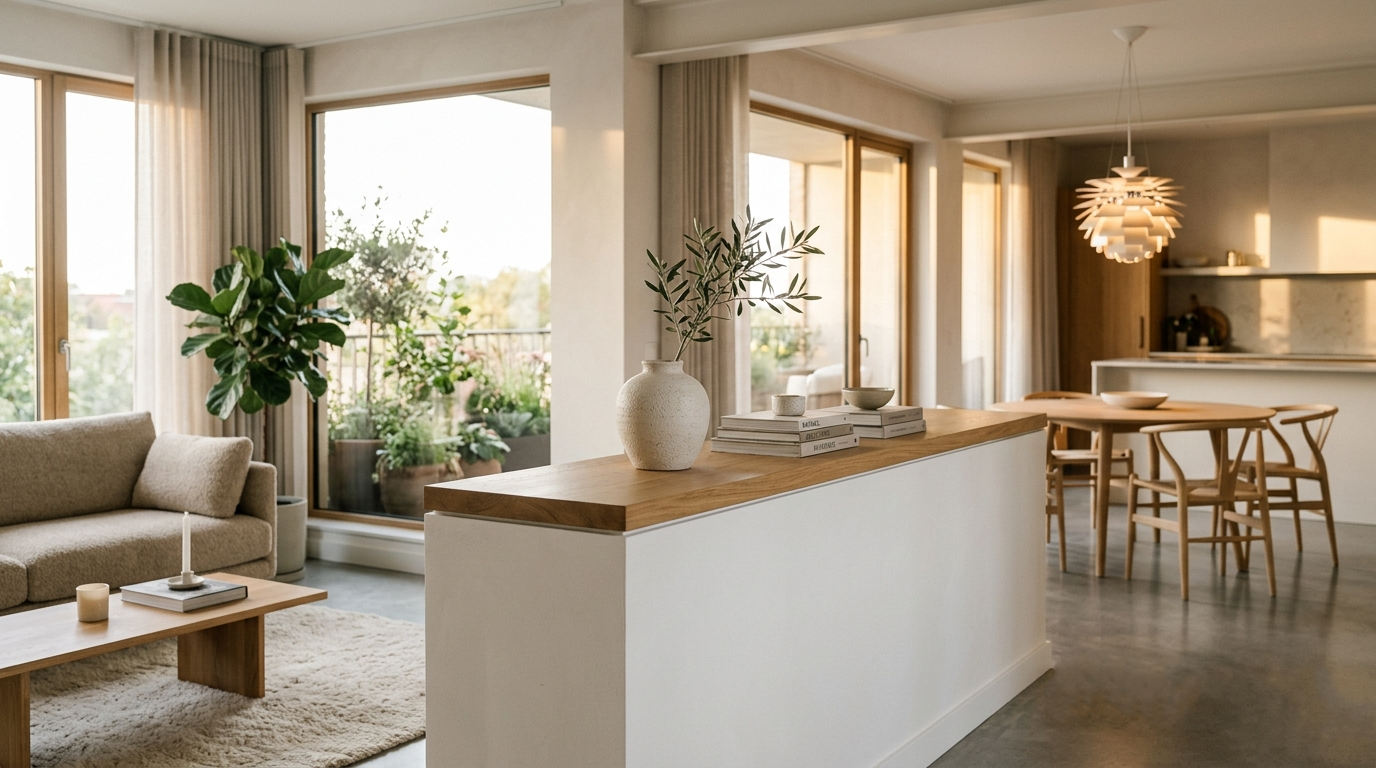

A fully open floor plan and a fully walled-off one are two extremes — and a permanent half-wall is often a better fit than either. It keeps sightlines and light moving between spaces while still giving each zone a sense of definition that a completely open plan doesn’t offer. Here’s where this works well.
Why This Actually Helps
This connects to two things we’ve covered elsewhere on the site with real research behind them: humans tend to respond well to spaces offering both an open view and a sense of enclosure at the same time (the “prospect-refuge” principle from environmental psychology), and open-plan living has real, measurable acoustic downsides — background noise and reduced privacy genuinely affect focus and comfort. A half-wall is a practical middle point between those two research-backed observations: enough openness to keep a “prospect” view of the room, enough structure to create a partial “refuge.”
It’s also worth being accurate about layout preference broadly: real survey data shows Americans are close to evenly split between open and more traditional closed layouts (51% vs. 49% in one 2023 survey) — this isn’t a settled trend in either direction, just a genuinely useful middle-ground option worth considering regardless of which side of that split you’re on.
We’ve covered other permanent, semi-open zoning strategies in more depth elsewhere — including zoning a space without building walls and open shelving as a room divider — worth a look if a half-wall isn’t quite the right fit for your layout.
Five Practical Applications
A media or fireplace plinth between living and dining zones. A roughly waist-to-chest-height (around 42″) wall segment anchored by a fireplace or media unit defines the boundary between two adjacent rooms without blocking sightlines or light above that height.
A raised “pony wall” behind a kitchen island. A partial wall on the living-room side of an island hides countertop clutter from the seating area while keeping the cook connected to the conversation — solving a real everyday annoyance of fully open kitchen-living layouts.
A floating headboard wall in a primary suite. A wall section (roughly 5 feet) that doesn’t reach the ceiling, positioned behind the bed, can create a small wardrobe or dressing zone on the other side without needing a fully separate room.
A hybrid half-wall with a glass clerestory above it for a home office. Solid wall below eye level for visual and acoustic separation, glass above it (steel-framed or simple clerestory windows) to keep daylight and a sense of connection to the rest of the home — a genuinely useful setup for a work-from-home space that still needs some real separation from household noise.
Lighting the top edge. A recessed LED channel along the top of any half-wall reads as an intentional architectural detail rather than an unfinished partial wall — a small detail that makes the difference between “half-built” and “designed this way on purpose.”
The Honest Trade-off
A half-wall is still a real construction project — it’s not reversible the way a curtain or bookcase divider is, and it needs proper framing, not just a stud wall stopped short. If you’re not sure you want a permanent change, it’s worth living with a temporary divider in the same spot for a few weeks first to confirm the layout actually works for how you use the space.
Bottom Line
A half-wall isn’t a compromise so much as a genuinely different tool — it solves for partial privacy and zoning in situations where either a full wall or no wall at all would be the wrong call. Used in the right spot, it gives a room definition without cutting off the light and connection that made an open plan appealing in the first place.
Sources: Jay Appleton’s prospect-refuge theory (environmental psychology, “The Experience of Landscape,” 1975); acoustic/cognitive-load research on open-plan noise; Rocket Mortgage / NAR-cited 2023 homebuyer layout preference survey (51% open / 49% traditional).
