
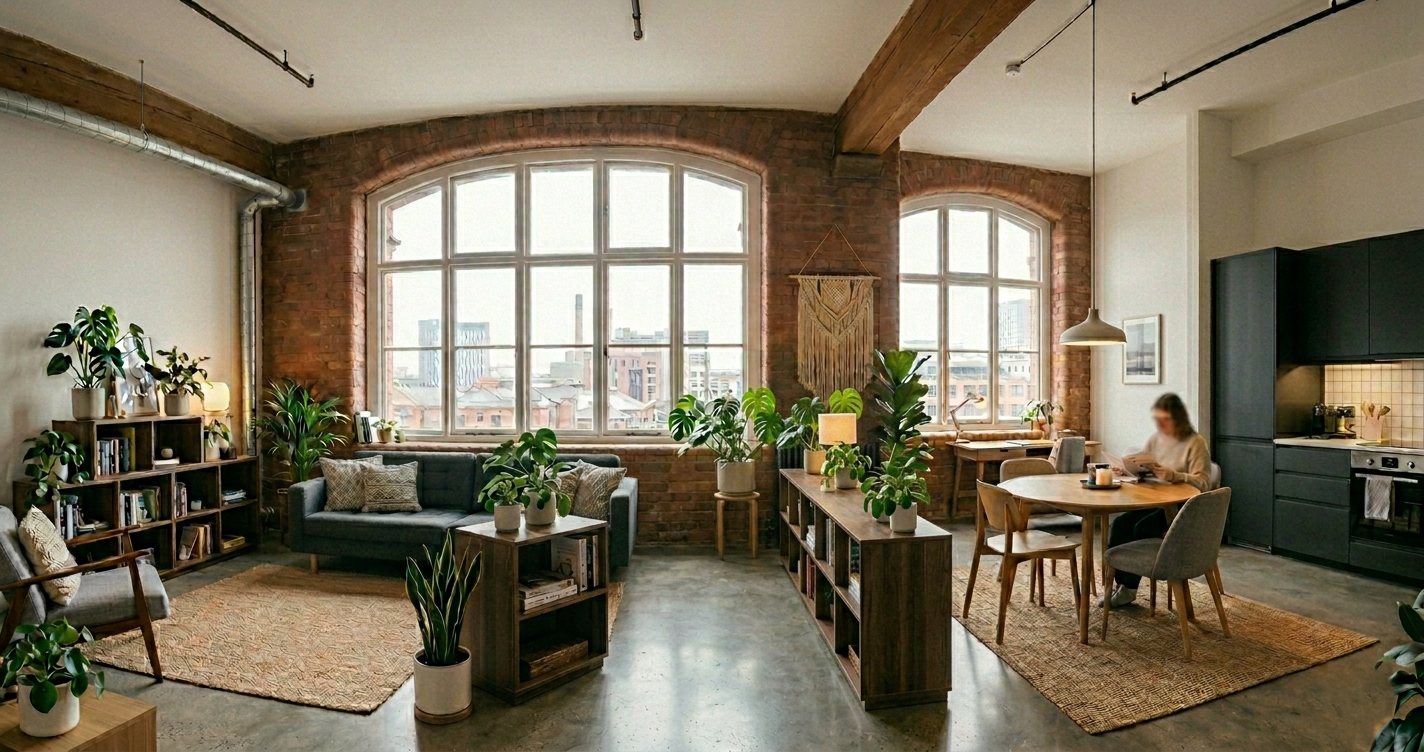

Open-plan living has real, well-documented downsides: no acoustic privacy, every mess visible from every angle, no way to separate work from rest when both happen in the same room. That doesn’t mean the answer is going back to fully walled-off rooms — permanent, semi-open architectural interventions can zone a space without sealing it off completely. Here’s how to do that well.
This Is a Real Shift, Not Just a Trend Claim
Open-plan living isn’t dying overnight, but preference has genuinely become more split than it was during the format’s peak popularity. A 2023 Rocket Mortgage survey found 51% of Americans prefer an open layout, with 49% preferring a more traditional, closed one — nearly an even split, which is a meaningful change from when open-plan was the default assumption. Designers interviewed by outlets like Homes & Gardens and House Beautiful in 2025–2026 have pointed to a consistent driver: the pandemic-era shift to working, schooling, and relaxing in the same home at the same time exposed how little privacy fully open layouts actually offer.
The Glazed Partition
A floor-to-ceiling steel-framed glass partition zones a space while still passing light through it. Reeded, fluted, or lightly smoked glass obscures direct sightlines without blocking brightness — useful between a home office and a living area, where you want acoustic and visual separation but not a fully closed-off room.
Zoning by Floor Height
A sunken living area or a slightly raised platform creates a zone shift without any vertical wall at all — purely through a change in floor level. This look has gotten real design-press attention recently as a way to define a space subtly; treat that as an aesthetic option worth considering rather than a claimed universal resurgence.
Zoning by Ceiling and Flooring
Contrasting ceiling treatments (a wood canopy over one zone, plaster over another) or a flooring material change between adjacent areas creates a visual boundary the eye reads clearly, even with no physical barrier at all.
A Freestanding, Double-Sided Fireplace
A central fireplace pier that opens to both adjacent zones shares warmth and light between them while still acting as a strong visual divider. Whether it creates “emotional privacy” is a matter of personal experience rather than something that can be stated as fact — but as a physical and visual anchor, it’s a genuinely effective zoning tool.
Furniture as a Soft Boundary
A modular sofa arranged perpendicular to a walkway can function like a low half-wall, defining a seating zone without any construction at all. A rug that extends a bit past the furniture’s edges (a general guideline, not a fixed rule — a few inches to half a foot works well in most rooms) helps visually anchor the grouping as its own zone.
Bottom Line
The choice isn’t really “wall or no wall” — it’s about how much separation a space actually needs. Real survey data shows preferences are genuinely split, not settled, so treat these as options to zone a space to the degree that fits how you actually live, not a trend to follow because it’s declared “over.”
Sources: Rocket Mortgage 2023 homebuyer preference survey (cited via National Association of Realtors); design-trend reporting from Homes & Gardens and House Beautiful, 2025–2026.

[…] covered other permanent, semi-open zoning strategies in more depth elsewhere — including zoning a space without building walls and open shelving as a room divider — worth a look if a half-wall isn’t quite the right fit […]