
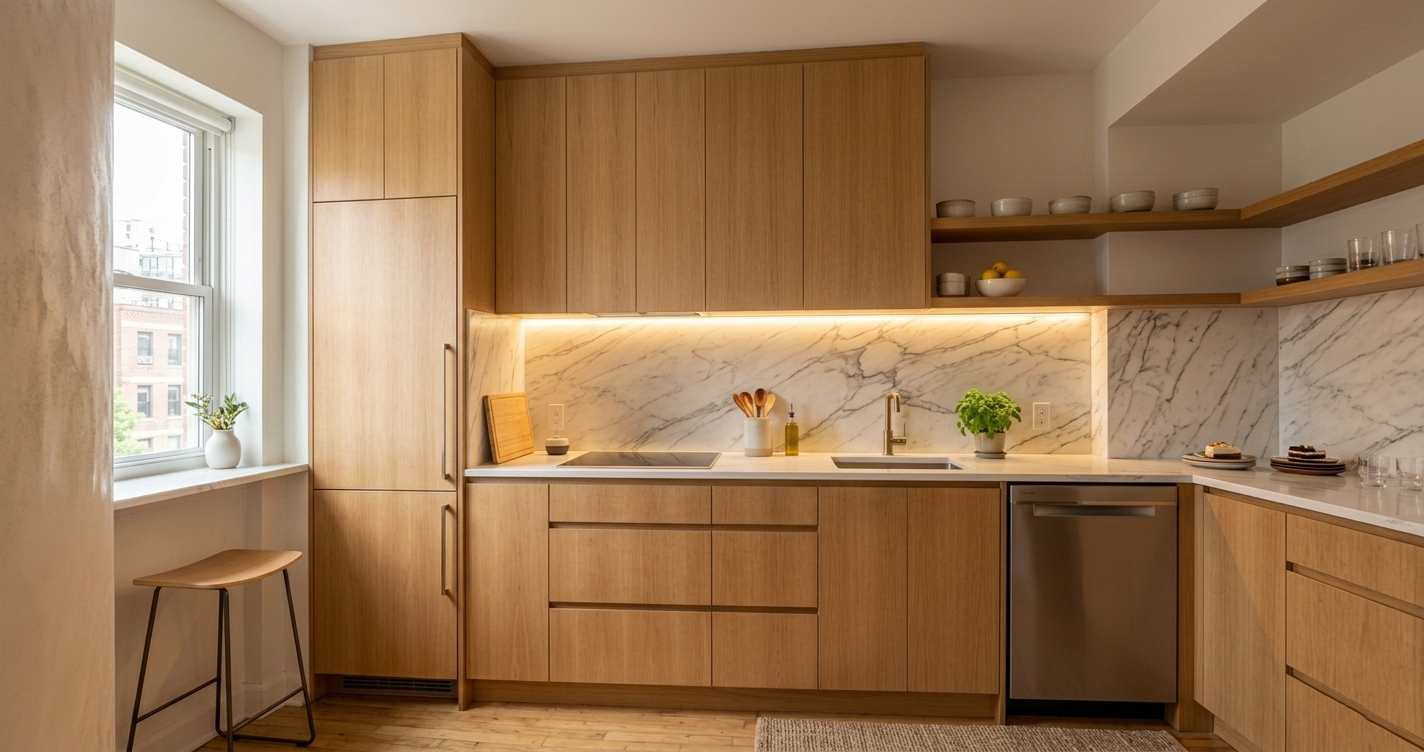

A larger kitchen isn’t automatically a better one. In a small footprint, every material choice and sightline matters more, not less — which means precision does more work than square footage. Here’s what actually makes a compact kitchen feel considered rather than cramped.
Why Visual Clutter Feels Smaller Than It Is
This isn’t just a design opinion — a room’s visible complexity measurably affects how spacious it feels and even how people judge its actual size. Research on interior surface patterns found that denser, busier visual patterns lead people to both rate a room as less spacious and misjudge its physical dimensions as smaller, compared to the same room with simpler surfaces. The same underlying principle applies to cabinetry: every visible hinge, gap, and handle adds visual complexity, and in a small kitchen, that complexity has an outsized effect on how the room reads.
Practical application: running cabinetry floor-to-ceiling in a single matte material — wire-brushed white oak veneer, smoked eucalyptus, or matte lacquer — with hidden, integrated hardware reduces that visual noise. The cabinetry reads as one continuous surface rather than a row of individual boxes.
Hiding the Appliances
Full concealment — a flush-mount induction cooktop instead of a visible range, ventilation handled through a downdraft or recessed ceiling mount, no freestanding fridge or microwave in view — removes another category of visual interruption. Whether this “tricks the brain” into anything is overstating it; more accurately, it just removes visual noise from a small space, the same underlying principle as the millwork point above, applied to appliances instead of cabinet doors.
One Continuous Material for Stone
Running a single natural stone slab across both the countertop and a full-height backsplash — rather than mixing a countertop material with separate backsplash tile — creates one continuous visual plane instead of a seam the eye has to process. In a small kitchen, fewer material transitions generally reads as more intentional.
Making the Interior Work Harder
Soft-close tandem drawer systems, built-in charging stations, and blind-corner pull-out systems get more usable storage out of the same footprint than static shelving. Heavy-duty drawer hardware varies by manufacturer, but well-built systems are commonly rated to hold substantial loads — check the specific hardware’s rating rather than assuming a number, since this varies significantly by brand and drawer size.
Layered Lighting, Not One Fixture
Three layers tend to work better than a single overhead light in a small kitchen:
- Task lighting — LED strips under upper cabinets, focused on counters where you actually work.
- Ambient definition — a recessed LED strip at the toe-kick creates a subtle “floating” visual effect that makes lower cabinetry feel lighter.
- Character lighting — one or two sculptural pendant fixtures or a plaster spotlight for a focal point.
The Honest Trade-off
Full concealment and continuous stone slabs cost real money — flush appliances, integrated ventilation, and monolithic stone are all premium-tier choices, not budget ones. If cost is a constraint, the millwork and lighting principles above deliver a meaningful chunk of the visual-clutter reduction on their own, even without the full appliance-concealment budget.
Bottom Line
A small kitchen doesn’t have to compromise on feeling considered and calm — but it does need more discipline in material and hardware choices than a larger space would require, since a small room has less visual room to absorb complexity. Fewer materials, fewer visible seams, and hidden hardware do more work here than they would in a bigger kitchen.
Sources: peer-reviewed research on visual pattern scale and perceived room spaciousness (published research on wallpaper/surface pattern effects on spatial perception).
